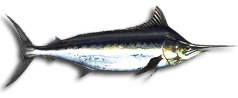
Black
Marlin (Makaira indica)
OTHER NAMES Suji , Mersuji
SPECIES IDENTIFICATION Long powerful
slightly compressed body rising rapidly to the top of the head. The upper
jaw is elongated to form a long, slender lance or spear. There are 2 dorsal
fins, the first is long and initially high, the second, smaller and composed
of six or seven rays. There are also two anal fins while the pectoral
fins are stiff and cannot be folded against the body. Colouration is typically
blur-black on the back becoming silver white on the flanks below the lateral
line.
SIZE Although known to exceed 700
kg in other parts of the world, the Black Marlin in malaysia usually range
between 50kg and 150kg.
SPORT FISHING NOTES The South China
Sea is believed to be part of the Black Marlin migratory route. A pelagic
fish roaming the pacific and Indian oceans, the Marlin appears regularly
along deep water coastlines and around oceanic islands. Trolling with
fish bait and skirts are common practice and drifting live bait or squid
also produce results. However, in the waters around Pulau Aur and Pulau
Dayang off Peninsula Malaysia’s east coast, fish attracting devices (Unjang)
made of bamboo and palm fronds are placed in the sea by local fishermen
to attract schooling bait fish. It is around these devices that Marlin
angling is best. Marlin makes spectacular runs and leaps when hooked.
They can be taken from March to October, however, the best period is June
to September. Medium to heavy tackle is recommended.
LOCATION Pulau
Aur, Pulau
Dayang, Pulau Pemanggil, Pulau
Tioman, Labuan and Mabul.
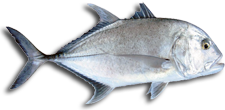
Giant Trevally (Caranx ignobilis)
OTHER NAMES Turrum, Ulua, Belitong.
SPECIES IDENTIFICATION Tallish body
with large convex head and narrow caudal peduncle with 2 keels composed
of raised bony plates on either side of the terminal part of the lateral
line. A small oval shaped scaled area is found on the breast in front
of the ventral fins, otherwise scaleless. First dorsal fin has 8 spines
and second dorsal fin 17-20 soft rays. The anal fins has 3 spines and
15-17 soft rays. The tail is forked. Colouration varies but usually grey-blue
with brownish tints on the back. Silver flanks and belly.
SIZE Up to 60kg but generally 10-30kg.
SPORT FISHING NOTES Prefers rocky
outcrops, reefs and rapidly sloping seabeds. Found commonly around isolated
rocky islands. Adults tend to be sedentary but young fish form small groups.
A very powerful fish that dives deep when hooked. Will take most baits
and lures, but of late poppers cast to rocky shores and jigging have proved
successful. Commonly found with various other Jack species. Medium to
medium heavy tackle.
LOCATION Most areas of Malaysia especially
outer islands and shoals in the South China Sea.
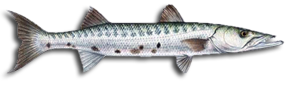
Great Barracuda (Sphyraena barracuda)
OTHER NAMES Alu-alu, Kacang, Cuda,
Sea Pike.
SPECIES IDENTIFICATION Long cylindrical
body with long pointed snout and a mouthfull of canine teeth. First dorsal
fin has 5 spines and the second 10 soft rays. Irregular dark blotches
are common on the lower flanks. Colouration varies from greyish to greenish
brown on the back to silvery flanks and belly.
Two distinct types are found in Malaysian
waters; one a yellow tipped tail, the other a black tipped tail.
SIZE Specimen of over 40kg have been
taken in Malaysian waters. However, 5-15kg is a common range.
SPORT FISHING NOTE Form schools when
young, becoming solitary when mature. Will attack anything that moves
when in a feeding frenzy. Wire leader is necessary when targeting Barracuda.
Medium tackle.
LOCATION Found In almost all waters
and environments.
Narrowbarred Mackerel (Scomberomorus commerson)

OTHER NAMES Tenggiri, Tanguigue,
Giant Mackerel.
SPECIES IDENTIFICATION Elongated
body slightly compressed on the flanks. Pointed snout with large mouth
and big strong teeth. Two dorsal fins close together, the first is long
and low, the second short and taller. Dorsal and anal fins followed by
8-10 finlets. Back dark blue in colour with lower flanks and belly being
silvery. Flanks also have irregular vertical wavy stripes.
SIZE Up to 25kg in Malaysian waters.
SPORT FISHING NOTES A highly rated
pelagic game fish. Form schools but larger specimens tend to be solitary.
Usually caught trolling around islands and rocky outcrops. Furious fighter
swimming rapidly when hooked. Will sometimes leap. Wire leader recommended.
Will also take drifted live and dead bait. Best fishing times tend to
be early morning and evenings. Main season is February to June but available
year round in lesser numbers. Medium tackle.
LOCATION Most Malaysian waters, preferring
islands and shoals.
Grouper (Serranidae)

OTHER NAMES Kerapu, Sea Bass.
SPECIES IDENTIFICATION Robust fish
with a generally typical well known bass shape. Mouth is large bearing
inwardly pointing teeth. Enlarged canine teeth usually present in front
jaws. Dorsal fins have between 7-12 strong spines with 10 to 10 soft rays.
The caudal fin is usually rounded, squared or crescent shaped, never forked.
Groupers vary in size and colour from dark to light and red to black,
many species having a speckled pattern.
SIZE There are over 30 species of
Grouper in Malaysian waters and size varies between species. However,
some of the larger species can grow to over 300kg. Average specimens are
from 2 to 20kg.
SPORT FISHING NOTES A strong powerful
fish that heads for underwater shelters in rocks and corals when hooked
often snagging or snapping the angler’s line. Tires rather quickly for
its size. The larger specimens are generally caught in deeper waters,
especially in holes, around rocky and coral bottoms.
LOCATION Widely distributed throughout
Malaysian waters.
Snappers (Lutjanidae)
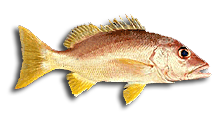
OTHER NAMES Seaperch, Jobfishes,
Ikan Merah (Red Snapper), Jenahak (Golden Snapper).
SPECIES IDENTIFICATION Perch like
fishes, snappers are a mostly reef dwelling marine species. Generally
an oblong body shape, compressed and deep with a convex dorsal profile.
Many species are available with some having a noticeable blotch towards
the tail end. The Malay-Indonesian-Melanisian Archipelago is the homeland
of these often very brightly coloured fish species.
SIZE The most commonly targeted snappers
range between 2-7kg.
SPORT FISHING NOTES Mainly bottom
dwellers feeding on fish, crustaceans and squid. Snappers fight well and
provide great sport on light to medium tackle. Larger specimens are often
landed at night.
LOCATION All Malaysian waters, reefs,
rocky outcrops and deep drop offs.
Jacks (Carangidae)
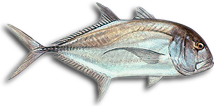
OTHER NAMES Scad, Trevally, Crevalle,
Cermin, Jemudok.
SPECIES IDENTIFICATION Body variable
in size, head compressed, snout often blunt with fine small scales. With
over 25 species commonly found, it is relatively difficult to describe
all of them. However, most anglers are quite familiar with some of the
species as this family has a wide distribution in tropical family has
a wide distribution in tropical and sub tropical waters atround the world.
SIZE 1 to 50kg.
SPORT FISHING NOTES Fights hard,
dives deep. Pound for pound, something to contend with. Usually travel
in schools.
LOCATION Throughout Malaysia – reefs,
rocky island shores, deep holes and undersea rocky outcrops. Depth does
not seem to matter.
Rays (Batoidei)
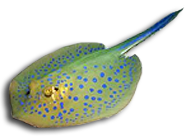
OTHER NAMES Stingray, Sawfishes,
Devilray, Shovelnose, Guitar Fish.
SPECIES IDENTIFICATION 10 families,
and 21 species of the fish so far have been recorded in Malaysian waters
with many different shapes, it is not easy to provide a general description.
However, all rays have a flattened body with moderately to broadly enlarged
pectoral fins. The mouth and gill slits are on the underside and the anal
fin is absent. The dorsal fin when present is over the tail. Tail is long,
slender, and often whip like. In many species, the tail houses 1 5o 3
spines, some serated, that can cause great pain from a venom injected.
Should a spine pierce a flesh, medical assistance must be sought. Pain
can be relieved by soaking in hot water of about 50° C for at least an
hour as the venom is heat labile.
SIZE Sawfish can grow up to about
6m length. The shovelnose up to 3m. General stingrays range from a few
kg to 50kg with average catches from 5 to 25kg.
SPORT FISHING NOTES Primarily bottom
dwellers, they can be found from estuaries to deep sea. Prefers muddy
or sandy bottoms and will take most types of bait offered. Very strong
with larger specimens throughly testing your strength.
LOCATION Throughout Malaysia. |